Warren C. Volles
Dubai’s Windcatchers: Environment-Friendly Alternatives to Air Conditioning Units
While walking through the Al Fahidi Historical Neighborhood of Dubai, I was fascinated by the windcatchers and became determined to learn how they cooled the buildings.

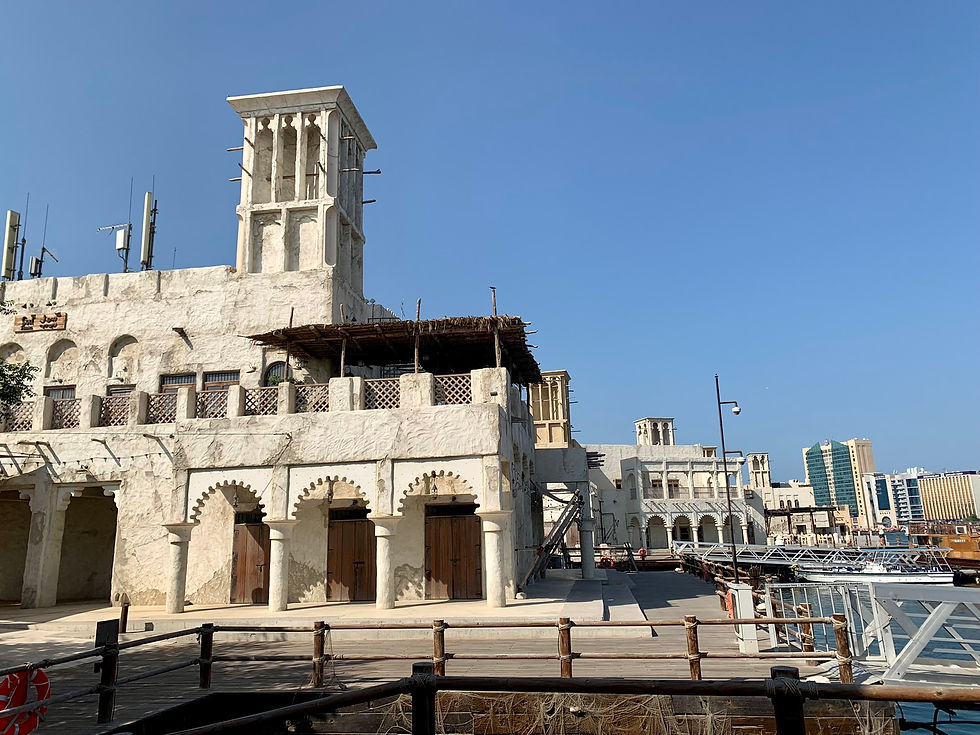
Windcatchers are traditional Islamic architectural elements that are mounted on rooftops to passively ventilate and cool buildings in hot climates. They are tower-like structures with openings near the top that capture cool air from the outside and allow hot air from the building to escape. In Dubai, United Arab Emirates, windcatchers are called "barjeel" in Arabic. They can be found on many traditional buildings within the Al Fahidi Historical Neighborhood, including the Sheikh Mohammed Centre for Cultural Understanding, the Al Seef Heritage Hotel, and homes.


Diagram of airflow through a windcatcher
by Warren Volles
A traditional windcatcher works through pressure gradients and convection, a heat transfer process that causes cooler air to sink and warmer air to rise. As the cool wind blows against the windcatcher, it creates an area of higher pressure on the windward side (facing the wind) and a corresponding area of lower pressure on the leeward side (protected from the wind). This pressure gradient drives the cool air into the windcatcher openings on the leeward side, which is then directed downward into the building. As the cool air circulates through the interior spaces of the building, the hot air from the building exits upward through the windcatcher openings on the windward side. This continuous airflow through the windcatcher creates a natural ventilation system that helps maintain comfortable indoor temperatures inside the building.

Sketch of a wall painting from Nebamun's tomb depicting a windcatcher on the roof of a home
Dwelling house in Ancient Egypt.
Source: Reprinted from Nordisk familjebok, Vol. 4, Till art. Byggnadskonst. I, 1905. In the public domain.
Although we have yet to determine exactly where the first windcatchers came from, evidence suggests that they were used thousands of years ago in North Africa and the Middle East. In Egypt, archaeologists found paintings of what appear to be windcatchers on the roof of a home. These paintings from around 1300 BCE were on the walls of the tomb of Nebamun. However, there are indications that windcatchers may have originated in Iran, where architects discovered chimney-like structures in the ruins of a fire temple from 4000 BCE. Since there are no ashes in the fire pit, the architects claim that the chimneys were likely windcatchers.
Windcatchers began to appear in Dubai during the pearl trade in the late 19th and early 20th centuries. At that time, builders came from Iran to Dubai primarily due to economic opportunities. They helped construct mosques, forts, and other structures that were needed to support Dubai's growing population and economy. Their expertise in traditional building techniques and materials to combat the intense heat in the desert environment was particularly useful.
Additional Insights
More recently, modern windcatchers were developed to provide a more environmentally friendly alternative to air conditioning units. Many of these new windcatchers are automated with sensor-controlled panels and incorporate other sustainable design features, such as solar-powered fans. For example, windcatchers were installed at the Zion National Park Visitor Center in Utah as part of a green energy management system to reduce energy consumption and carbon footprint. This system provided a 70% reduction in energy use.
Windcatcher on the roof of the Zion National Park Visitor Center
Photo by Robb Williamson, courtesy of the National Renewable Energy Laboratory (NREL).

References
Assi, E. (2022). Layers of meaning and evolution of cultural identity: The case of wind towers in Dubai. Conservation, 2(1), 38–50. https://doi.org/10.3390/conservation2010004
Grube, E., Dickie, J., Grabar, O., Sims, E., Lewcock, R., Jones, D., & Petherbridge, G. (1978). Architecture of the Islamic world: Its history and social meaning (G. Michell, Ed.). Thames & Hudson. https://archive.org/details/01isart/mode/1up
Nessim, M., Elshabshiri, A., Bassily, V., Soliman, N., Tarabieh, K., & Goubran, S. (2023). The rise and evolution of wind tower designs in Egypt and the Middle East. Sustainability, 15, 10881. https://doi.org/10.3390/su151410881
Nordisk familjebok. (1905). Dwelling house in Ancient Egypt [Illustration]. In Nordisk familjebok (Vol. 4, Till art. Byggnadskonst. I). https://commons.wikimedia.org/wiki/File:Fornegyptiska_boningshus.jpg
Pirhayati, M., Ainechi, S., Torkjazi, M., & Ashrafi, E. (2013). Ancient Iran, the origin land of wind catcher in the world. Research Journal of Environmental and Earth Sciences, 5(8), 433–439. https://doi.org/10.19026/rjees.5.5671
Roaf, S. (2005, May). Air-conditioning avoidance: Lessons from the windcatchers of Iran. In Proc. Conf. "Passive and Low Energy Cooling for the Built Environment," Santorini, Greece. https://www.researchgate.net/publication/237768160_Air-conditioning_avoidance_Lessons_from_the_windcatchers_of_Iran
Saadatian, O., Haw, L., Sopian, K., & Sulaiman, M. (2012). Review of windcatcher technologies. Renewable and Sustainable Energy Reviews, 16, 1477–1495. https://doi.org/10.1016/j.rser.2011.11.037
Sangdeh, P., & Nasrollahi, N. (2002). Windcatchers and their applications in contemporary architecture. Energy and Built Environment, 3(1), 56–72. https://doi.org/10.1016/j.enbenv.2020.10.005
Solaripedia. (n.d.). Project: Zion National Park Visitors Center (Utah, USA). https://www.solaripedia.com/13/33/373/zion_cool_tower_inside.html
Solberg, C., & Rich, J. (2014, May 13). Sustainable construction methods using ancient BAD GIR (wind catcher) technology. In Construction Research Congress 2014: Construction in a Global Network (pp. 1576–1585). https://doi.org/10.1061/9780784413517.161
U.S. Department of Energy. (2000). Zion National Park Visitor Center: A sustainable building for the future (DOE/GO-102000-1061). National Renewable Energy Laboratory. https://www.nps.gov/zion/learn/nature/upload/DOE-Brochure.pdf