Warren C. Volles
The Chengdu Research Base: A Model of Sustainable Engineering for Animal Habitats
The Chengdu Research Base shows that caring for animals and the environment can go hand in hand. It is not just a fun place to see pandas—it is also an example of how sustainable engineering design can support wildlife and educate people at the same time.


The Chengdu Research Base of Giant Panda Breeding is located in Chengdu, a large city in southwest China. Most people visit to see the giant pandas, but the base is more than just a place to observe these adorable animals. It is also a model for eco-friendly animal habitats and sustainable tourism.
The base was created to help protect and increase the panda population. Scientists and caretakers work every day to take care of the pandas, study their behavior, and help them survive in the wild. At the same time, they have built the base in a way that respects nature. The Chengdu base uses natural landscaping to make the environment feel like the pandas’ natural home. Trees, bamboo, and ponds are placed carefully to match what pandas would see in the wild.
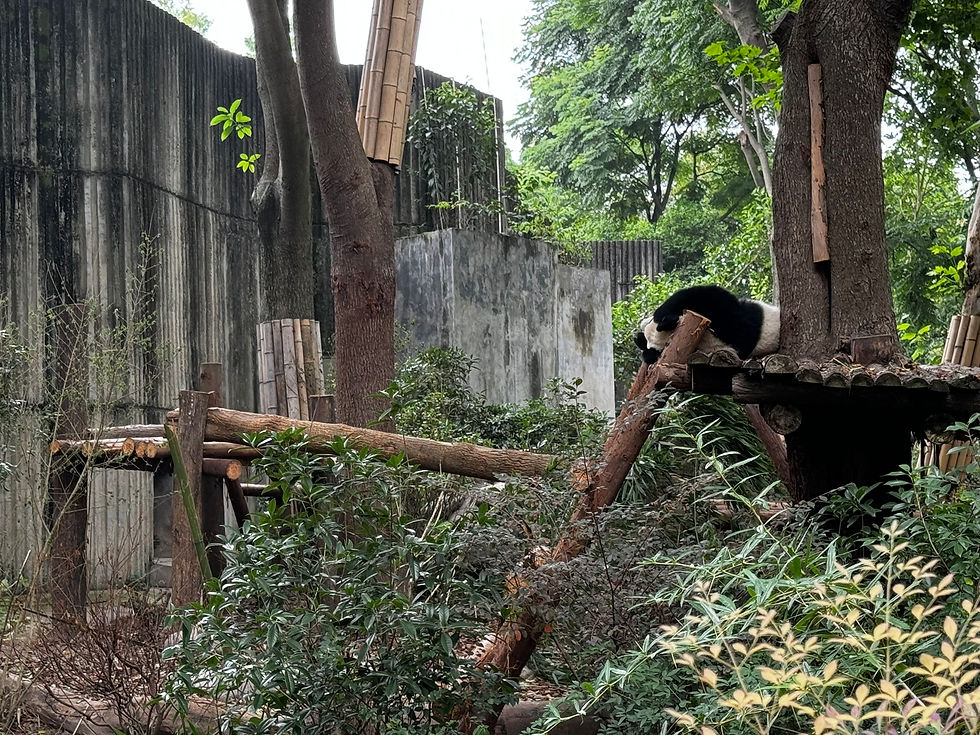


The base also uses solar heating, which saves energy and reduces pollution. In addition, it follows strict conservation practices. This means they recycle, avoid waste, and protect other local plants and animals too.

Photo: The Giant Panda Museum

Video: giant panda eating bamboo
Even though giant pandas are members of the carnivore group, their diet is about 99% plants. They eat mostly bamboo. They spend about 10 to 16 hours each day eating. Pandas chew slowly and use their strong jaws to crush the tough bamboo stalks. They eat many parts of the bamboo plant, including the leaves, stems, and shoots. Sometimes, pandas also eat small animals or eggs, but this is rare.

Photo: Red Panda Delivery House
The Chengdu Research Base is also home to red pandas. Red pandas are smaller than giant pandas and look more like raccoons. They have reddish-brown fur, fluffy tails, and round faces. Red pandas live in trees and are very good climbers. They eat mostly bamboo, but they also enjoy fruit, berries, and small insects. At the Chengdu base, caretakers give them a safe space to climb, rest, and explore.

Additional Insights:
The Chengdu Panda Research Base welcomes nearly 50 million visitors each year, with a daily limit of 63,000 people. Tourists from all over the world visit the site. They learn about panda conservation and how humans can help protect wildlife. The base manages tourism carefully to avoid harming the animals or their habitats. Paths are built to guide visitors without disturbing the pandas, and loud noises are not allowed.
references:
Bai, W., Wei, W., Deng, H., & Wang, F. (2017). Microhabitat selection by giant pandas. Ecology and Evolution, 7(19), 7774–7782. https://doi.org/10.1002/ece3.3259
Chengdu Research Base of Giant Panda Breeding. (n.d.). Giant Panda Museum. https://m.panda.org.cn/en/education/framework/2023-07-16/7850.html
China Highlights. (2023, September 6). Chengdu Panda Base: Highlights, opening hours, map. https://www.chinahighlights.com/chengdu/attraction/chengdu-panda-breeding-and-research-center.htm
Guttridge-Hewitt, M. (2023). Sustainable practice: The Chengdu panda pavilions and immersive conservation. Architizer. https://architizer.com/blog/inspiration/stories/chengdu-panda-pavilions-immersive-conservation/
Sichuan Travel Guide. (n.d.). Chengdu Research Base of Giant Panda Breeding. https://www.sichuantravelguide.com/giant-panda/chengdu-panda-base.html
Smithsonian’s National Zoo & Conservation Biology Institute. (n.d.). Giant panda. https://nationalzoo.si.edu/animals/giant-panda
World Wildlife Fund. (n.d.). Red panda. https://www.worldwildlife.org/species/red-panda
Xue, B., & Zhang, L. (2022). Development strategy analysis of Chengdu Research Base of Giant Panda after COVID-19. Academic Journal of Business & Management, 4(18), 14–21. https://doi.org/10.25236/AJBM.2022.041804
Zhang, J., Hull, V., Huang, J., Zhou, S., Xu, W., Yang, H., & Liu, J. (2017). Modeling activity patterns of wildlife using time-series analysis. Ecology and Evolution, 7(7), 2575–2584. https://doi.org/10.1002/ece3.2878